
Everything on Phototherapy
Phototherapy – When is it recommended?
It is true that narrowband UV-B therapy (NB-UVB) constitutes one of the main treatment options for vitiligo.
It is effective particularly for non-segmental vitiligo and has shown to be the safest and most effective treatment for this skin condition.
BUT WHEN EXACTLY?
Can it be administered to those with skin lesions in the first 2 months upon the onset of Vitiligo? Of course not!
It is deemed appropriate to clarify the issue of “phototherapy”, to identify its advantages and disadvantages, and to see whether it is indeed essential and proper to use it as the only weapon against vitiligo.
The recent Vitiligo Working Group (VWG) recommendation on the administration of phototherapy in vitiligo patients is to use phototherapy (NB-UVB) when:

extensive skin lesions are evident
rapid spread of the skin condition is evident
patients with less extensive skin lesions applied known topical treatments that were used correctly but were not effective

Thus, in cases of 2-3 white patches and with the skin condition lasting for a few months, according to Vitiligo Working Group, certain topical medications are recommended and not phototherapy, even though it is safe for small children and pregnant women.


Who is considered an expert in Phototherapy?
One solution could be to wait and attend University clinics, where these exist, where there are experts on the specific skin condition.
But the patient has choices to make.
What needs to be determined is the person who truly has…
1) Doctor with Experience and Specialized Training in Vitiligo
Experience and expertise are gained by singular and persistent practice for many years, ONLY with one subject, vitiligo, learning alongside good specialist leukologists and with a large clientele exclusively of vitiligo patients.
Those who have many years of experience in cosmetic, aesthetic and classical dermatology and sometimes also see patients with vitiligo, whether they have sufficient experience in the difficult problem of vitiligo is determined by the patient with his judgment.
2) Expertise, knowledge of the subject and correct approach during physical examination
During the examination the client has the insight to distinguish between the 15 minute examination of a classic office and his thorough examination of at least 90 minutes at an organized vitiligo center such as the Vitiligo Center. Our machines:
- since 1996 the first UVA (only this existed then),
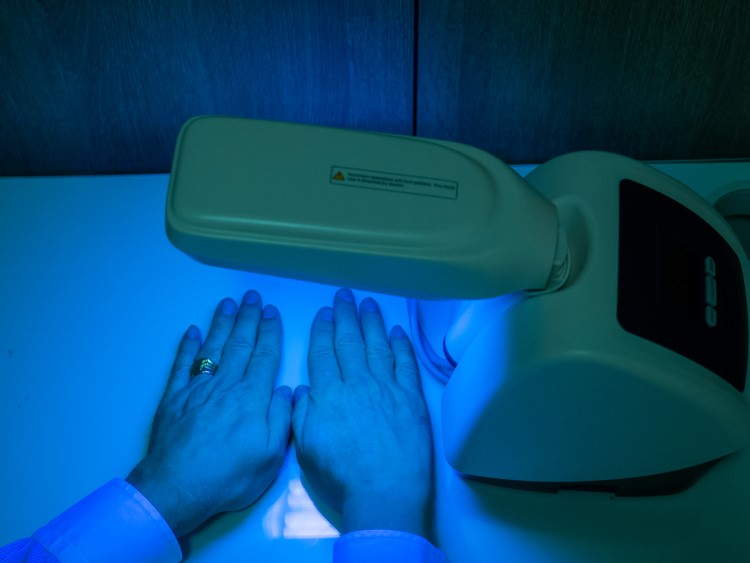
- since 2007 the waldmann UV 100 L cabin (Standard Version) which we have been using for 17 years!



3) Treatment effectiveness in the first 2-3 months
The effectiveness of the treatment is amazing with our personalized formulations (based on the criteria of the area, time of illness, age, phototype, etc.). The improvement is from 30% to 70% in the first trimester WITHOUT PHOTOTHERAPY.
However, when it is durable and on large or rigid surfaces, then we use it at a low cost (lamp change and maintenance, technician expenses, etc.) throughout the treatment of our clients.
Phototherapy equipment used

The optimal frequency of NB-UVB phototherapy administration is 2 to 3 times a week and the skin phototype of each patient plays a significant role in the maximum amount of radiation exposure.
As for combination treatments (antioxidants or oral corticosteroids), they aim to stabilize vitiligo lesions and induce repigmentation. Lastly, a reduced number of phototherapy sessions and reduced side effects are achieved with combination treatments, such as the use of our galenic formulations.
Thus, in cases of 2-3 white patches and with the skin condition lasting for a few months, according to Vitiligo Working Group, certain topical medications are recommended and not phototherapy, even though it is safe for small children and pregnant women.
Phototherapy – Genital Vitiligo
Vitiligo can affect all parts of the body including the genitals; it appears to affect both sexes in high percentages, in various anatomic sites, such as the scrotum, the penis, the glans in men, the vulva and all areas of the vagina in women, as well as the anus in both sexes.
1. Genitals are affected by vitiligo lesions which fall within the category of “mucocutaneous” lesions.
2. This type of vitiligo is more resilient to treatment and the attending physician must ensure to prevent symptoms from spreading.
3. Vitiligo is not a common skin condition and some doctors cannot provide a definite diagnosis of vitiligo using Wood’s lamp and resort to biopsy, often manifesting the Koebner phenomenon and extending the problem.

Treatment
1. Given the particular vulnerability of genitals, genital vitiligo should not be treated with psoralens and direct radiation.
2. The use of phototherapy might prove dangerous, due to the sensitivity of the penis and testicles as well as the vagina and vulva, specifically to UV radiation and heat. It is well known that increased testicular temperatures are directly associated with a decline of sperm production. It is believed that a continuous exposure to heat in the genitals may cause male infertility in the long term.
Phototherapy – Side effects
Let us look at the side effects of phototherapy

NBUVB radiation is relatively safe and this is one of the main reasons why it is considered a first-line treatment option for generalized vitiligo in adults as well as children. This is because the Excimer Light 308 can target lesions more effectively. But, due to the cost, the number of units is limited, so home transport is excluded on the one hand and, on the other, the chances of local irritation are high as you will find out after the first session!
Besides, all units operated in Greece are Excimer Light and not Excimer Laser, which are obviously more efficient and clearly much more expensive than Excimer Light. Comparisons, therefore, in terms of greater efficiency between Excimer Light and NBUVB are not valid.
On the contrary, I would say Excimer Light lacks nothing, as there are 200, 311 nm NB-UVB units at our centers that operate safely all over Greece with a small number of patients susceptible to limited side effects, mainly due to the negligence or excessive zeal of the patients.
Side effects from 311nm NBUVB Excimer Light 308 nm in vitiligo patients are as follows:
Short-term
- Erythema (redness)
- Itch
- Blisters
- Rash
- Dry skin
- Herpes
- Increased tanning around vitiligo patches
- Keratitis and conjunctivitis
Eye protection protocol during UV exposure must be strictly adhered to.
Long-term risk
It remains unclear and questions regarding UVB radiation and skin cancer, even as a rare occurrence, remain unanswered.
As the development of skin cancer in vitiligo patients appears to be very rare, it is reasonable to believe that NBUVB use in vitiligo patients makes them feel safe regarding the potential risk of malignancies.

What is the truth about Phototherapy?
We should first make clear that the 308 nm Excimer Laser, an intense pulsed light system, does not exist in Greece.
There are 308 nm Excimer lamp devices, which are clearly not the same and their use is limited only to clinics since the cost of rent is prohibitive.
Vitiligo stops progressing in children after 12 weeks of NB-UVB treatments, according to manufacturers and several attending physicians, and high repigmentation percentages are most commonly achieved, in our opinion, after the end of a one-year treatment.
Phototypes I and II (particularly phototype I) require much more time to achieve substantial repigmentation.
It is certain that NB UVB phototherapy is considered the “gold” standard in the treatment of vitiligo.
Results on the face and torso are clearly better and at shorter time intervals, especially for high skin phototypes.
The training and experience of presumed vitiligo specialists are inconsistent with the establishment of phototherapy as the only way to treat vitiligo.
Results on the extremities are satisfactory after a period of at least one year – often more.
Patience and perseverance are required to achieve repigmentation. This should be emphasized as long-term experience in phototherapy dictates.
Ongoing cases report several cases of burns (particularly on the face) from 308nm targeted phototherapy, especially in low skin phototypes.
It is unacceptable to treat cases of 2-3 relatively recent lesions on the face or body exclusively with phototherapy.
Who are the “very slow responders” to phototherapy?
In a study of 579 patients, Cabrera et al. attempted to develop a predictive model for the response rate of non-segmental vitiligo patients to NB-UVB phototherapy. Rates of response were classified as follows: very rapid, rapid, average, slow response and lastly, non-responders or very slow responders.
So, the authors referred to a new subgroup as “slow responders” who did not respond in the first 48 sessions. Finally, the Vitiligo Working Group committee observed an even slower group of responders. That is, patients with a response at 72 NB-UVB sessions minimum (“very slow responders”).
This practically means that we proceed with 72 sessions. THAT IS, after the sixth month of treatment, we can determine responsiveness to phototherapy for certain groups!
Special protection is required during treatment:
- Face (eye) protection
- male genital organs and nipples need to be protected in order to reduce the risk of genital malignancy
- a sunscreen should be applied to prevent burns

Why isn’t phototherapy the only treatment option for vitiligo in Vitiligo centers?
Our truly advanced experience in the field is due to the following:
The Waldmann whole-body cabin was purchased in 2007!
We have been using this Waldmann cabin for 17 years!
Finally, the portable NB UVB devices have been imported for 20 years from abroad and are available to our customers at a low cost (lamp change and maintenance, technician costs, etc.) throughout their treatment at their place or at our place.
So, apart from University clinics in Greece, we were the first to use phototherapy.
We have been in the field of vitiligo for 30 years and we believe that by using a combination of personalized galenic formulations we are the only ones who can promise definite improvement within the first two months and we keep our promises.
Where appropriate, phototherapy is ALSO used in combination, at a low cost (lamp change and maintenance, technician costs, etc.).